

Why Premium Supplements Cost More
Last Updated: October 23, 2026
Quick Summary
Premium supplements cost more because they use certified organic ingredients, third-party testing, GMP-certified manufacturing, and standardized extracts with verified potency, whereas budget supplements often skip these steps and offer no guarantee of consistency or purity.
- Third-party testing costs $500 to $2,000 per batch and verifies label accuracy, purity, and safety.
- Standardized extracts guarantee consistent active compound concentration across batches, unlike non-standardized extracts.
- NSF or USP certification requires independent audits and unannounced facility inspections, adding thousands in annual overhead.
- Cost per serving, not bottle price, is the meaningful comparison when ingredients and testing are equivalent.
Table of Contents
- Why Premium Supplements Cost More: The Real Factors
- Ingredient Sourcing and Raw-Material Quality
- Manufacturing Standards and Facility Certifications
- Third-Party Tested Supplements: Verification That Costs Money
- Supplement Cost Per Serving: Breaking Down the Real Value
- Are Expensive Supplements Worth It? When Price Reflects Quality
- How to Compare Supplement Labels and Spot Hidden Costs
- Frequently Asked Questions
Why Premium Supplements Cost More: The Real Factors
Compare supplement prices online and the gap can be shocking: a basic ashwagandha bottle might cost $15, a premium version $85 or more, a five-fold difference for what looks like the same thing, yet premium supplements cost significantly more for documented reasons.
At Dr. K's Vital Edge, we've spent years analyzing what separates a cheap supplement from a premium one: ingredient sourcing, manufacturing rigor, third-party testing, and formulation science. Here's where the money actually goes.
Ingredient Sourcing and Raw-Material Quality
Premium supplements start with premium raw materials, and this is where costs diverge most dramatically.
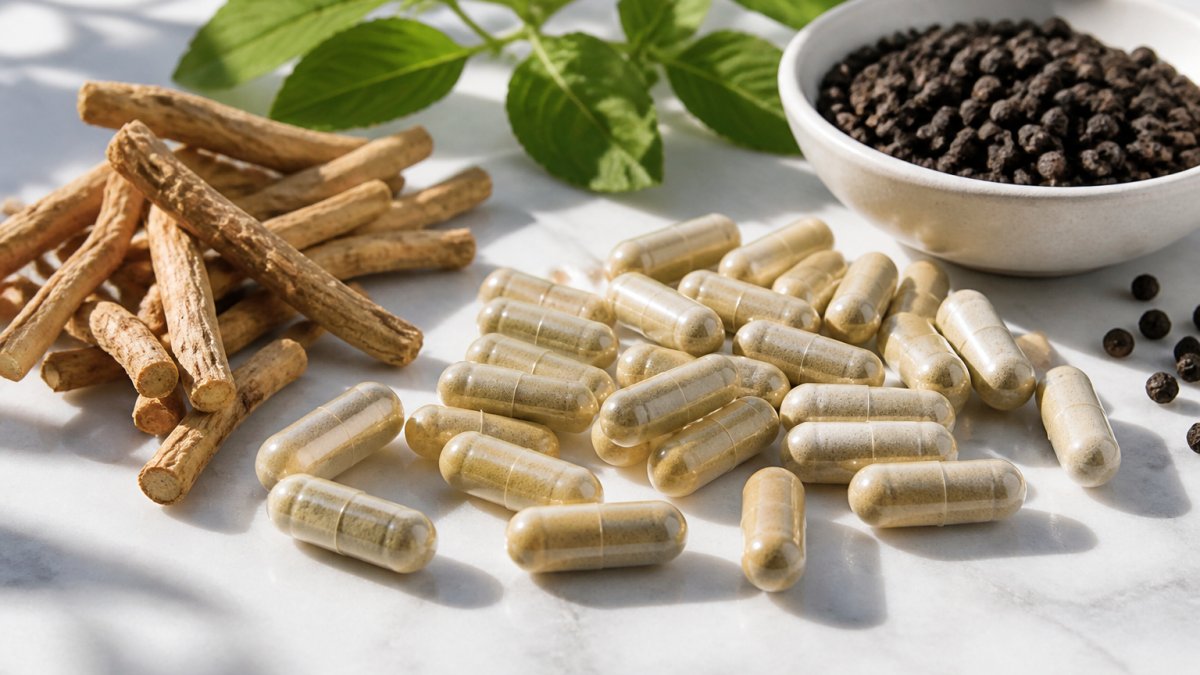
Consider sourcing alone:
- Bulk commodity ingredients: Purchased from the cheapest available supplier, often with minimal traceability
- Traceable ingredients: Sourced from known farms or regions, with documentation of growing practices
- Certified organic ingredients: Meet USDA organic standards, requiring pesticide-free verification and third-party inspection
Our organic ashwagandha uses certified organic root extract, paired with black pepper extract standardized to 95% piperine for consistent bioavailability. These choices cost more upfront but deliver predictable results.

Sourcing also affects purity. Premium suppliers run heavy metals testing, microbial screening, and pesticide residue analysis before selling raw materials; budget suppliers often skip these steps.
Manufacturing Standards and Facility Certifications
Where a supplement is made matters as much as what goes into it, and label certifications are only meaningful if you understand what each requires. Any facility making dietary supplements for sale in the U.S. must register with the FDA and follow the current Good Manufacturing Practice rule (21 CFR Part 111). That rule is the floor, not a seal you earn, a budget and a premium product can both be made in an FDA-registered, GMP-compliant facility; the difference is how far above the floor the operation goes. Here's what the common credentials actually mean, from weakest to strongest signal:
- FDA facility registration: The company has told the FDA it exists and what it makes. Registration is not an inspection and not an endorsement. Treat it as a starting point, not proof of quality.
- GMP compliance (21 CFR Part 111): Requires written procedures for receiving, testing, and releasing ingredients; master manufacturing records for every batch; equipment calibration; employee training; and complaint handling. The FDA inspects against this rule, but inspections are infrequent relative to the number of facilities, so compliance is largely self-attested between visits.
- NSF/ANSI 173 or USP verification: Independent, third-party audits of the facility and the product against published standards, including identity, potency, and contaminant limits. These programs require re-audits and unannounced facility inspections, which is why they cost more and appear on fewer labels.
What does this rigor cost? Third-party facility certification and the associated audit, documentation, and re-testing add meaningful overhead per production run, often several thousand dollars a year in audit and program fees alone, before staff time for paperwork.
Manufacturing rigor also shows up in process controls that never appear on a label:
- Precise weighing and blending equipment rather than hand-measured batches
- Environmental controls for temperature and humidity to prevent degradation of sensitive ingredients
- Segregated or rigorously cleaned production lines to prevent cross-contamination between products
How to verify a certification claim: look up the brand or facility in the certifying body's public directory (NSF and USP both maintain searchable listings), and check that the certificate covers the specific product you are buying, not just the company.
A facility certification and a product certification are different things. 'Made in a GMP-certified facility' describes the building. 'NSF Certified' or 'USP Verified' on the product label describes the bottle in your hand. The second is the stronger claim, and it is the one worth paying for.
Third-Party Tested Supplements: Verification That Costs Money
Third-party testing is where premium and budget supplements diverge most visibly. An independent lab verifies:
- The label claim is accurate (the bottle says 600mg, does it actually contain 600mg?)
- No banned substances are present
- Heavy metals are below safe limits
This testing costs between $500 and $2,000 per batch, depending on scope. Budget supplements often skip it entirely, relying on the manufacturer's own testing, a conflict of interest.
Our ashwagandha is third-party tested for potency, purity, and heavy metals, and the certificate is available to customers. Budget supplements rarely offer this transparency: some claim third-party testing without doing it, and others test only select batches.
Supplement Cost Per Serving: Breaking Down the Real Value
Comparing prices by bottle is misleading. Compare by serving instead.
Our 90-day ashwagandha supply contains 90 servings at $84.99, $0.94 per serving.
But does that budget supplement actually work? If the dosage is inconsistent or the ingredient quality is poor, you're not getting a better deal, you're getting a cheaper placebo.
Compare these factors:
| Factor | Budget Supplement | Premium Supplement |
|---|---|---|
| Ingredient standardization | No | Yes, verified potency |
| Third-party testing | No | Yes, certificate available |
| Manufacturing standard | Basic FDA compliance | GMP-certified facility |
| Dosage consistency | Variable | Consistent, batch-tested |
| Ingredient sourcing | Bulk commodity | Traceable, often organic |
| Cost per serving | $0.40-0.60 | $0.80-1.50 |
The premium supplement costs more per serving but delivers a known dose of a verified ingredient from a controlled facility; the budget supplement offers no guarantees.
Ashwagandha (ORGANIC) 90-days →
If you take a supplement for four weeks and see no effect, you've wasted money regardless of price. A premium supplement that works is cheaper than a budget supplement that doesn't.
Are Expensive Supplements Worth It? When Price Reflects Quality
Premium supplements are worth it when price reflects actual quality differences, not marketing.
Premium pricing makes sense when you're paying for:
- Certified organic ingredients with traceability
- Third-party testing with public certificates
- GMP-certified manufacturing
Premium pricing does NOT make sense when you're paying for:
- Celebrity endorsements
- Fancy packaging
- Unverified claims about "supercharging" or "optimizing"
- A brand name alone
The test is simple: can you verify what you're paying for?
With our ashwagandha, you can verify:
- The ingredient is USDA organic certified
- The dose is 600mg per serving
- The black pepper extract is standardized to 95% piperine
- The product is third-party tested
All of this is documented and transparent. The premium price reflects these verifiable qualities.
A supplement that costs twice as much but offers no additional transparency or testing is probably overpriced.
How to Compare Supplement Labels and Spot Hidden Costs
Most supplement comparisons fail because people compare bottle prices instead of what they get per dose.
Step 1: Read the Supplement Facts panel in the right order.
- Serving size, how much you take per dose. A bottle that says '120 capsules' tells you nothing until you know whether a serving is one capsule or three.
- Servings per container, the real measure of how long the bottle lasts. Divide the bottle price by this number to get cost per serving.
- Active ingredients and amounts, in milligrams or micrograms, per serving.
- Other ingredients, everything below the line: fillers, binders, flow agents, capsule material.
Step 2: Calculate cost per effective dose, not cost per capsule.
This is the step almost no one does.
Example: Product A costs $18 for 60 capsules with a 500 mg serving, and the researched daily amount is 600 mg.
Step 3: Flag these label problems.
- Proprietary blends with no per-ingredient amounts. 'Herbal Complex 500 mg' hides how much of each herb is present. You cannot verify a dose you cannot see.
- 'Other ingredients' that outweigh the actives. If the active is 100 mg and the fillers total 400 mg, you are mostly buying excipients.
- No standardization statement on an extract. Without a standardized marker (for example, a stated percentage of a named compound), potency can swing batch to batch.
- Vague sourcing language. 'Natural' and 'herbal' carry no verification. Specific claims, a named extract, a stated standardization, a certification, can be checked.
Step 4: Verify the quality claims instead of trusting them.
Use this checklist and score each product:
- Is the active ingredient standardized to a stated marker?
- Is a third-party test certificate available, and does it cover the specific lot you are buying?
- Is the testing lab independent and, ideally, ISO 17025-accredited?
- Is the product or facility certified by NSF, USP, or an equivalent program you can look up in a public directory?
- Does the label disclose the full ingredient amounts, with no hidden blends?
- Is the facility GMP-compliant, and can the brand tell you how it verifies that beyond self-attestation?
- Does the brand publish a certificate of analysis (COA) that matches the lot number on your bottle?
This checklist is most valuable when you are choosing between two products at different price points for daily, long-term use. For occasional use, the verification effort may not be worth it, but the label-reading steps cost you nothing and take two minutes.
Frequently Asked Questions
Are expensive supplements always better than cheap ones?
Not always, but premium supplements typically offer measurable advantages. Higher prices often reflect superior ingredient sourcing, third-party testing, and manufacturing certifications. A cheap supplement may contain the listed ingredient but in lower potency or bioavailability. The key is comparing cost per serving and verifying third-party testing rather than assuming price alone determines quality. Some premium brands justify costs through clinical research and formulation expertise, while others mark up prices without corresponding quality gains.
What makes a supplement premium versus cheap?
Premium supplements differ in ingredient sourcing (organic vs. conventional), manufacturing standards (GMP certification, FDA-registered facilities), third-party testing (verification of purity and potency), and formulation research. Premium brands often use bioavailable forms of ingredients, add absorption enhancers like black pepper extract, and conduct clinical studies. Cheap supplements may use lower-grade raw materials, skip third-party testing, and use less effective ingredient forms. Dr. K's Vital Edge, for example, uses USDA Organic Ashwagandha with black pepper extract for superior absorption, features that increase production costs.
How do you calculate supplement cost per serving?
Divide the total price by the number of servings per bottle. If a 90-day supply costs $84.99 and contains 90 servings, the cost per serving is approximately $0.94. This metric matters because a cheaper bottle with fewer servings may actually cost more per dose. When comparing supplements, always check serving size and daily dosage requirements. Some supplements require 2-3 capsules daily, which increases the true cost per serving. Cost per serving helps you identify whether a premium supplement's higher price reflects better value or just brand markup.
Why do third-party tested supplements cost more?
Third-party testing adds direct production costs. Independent labs charge manufacturers to verify that supplements contain the labeled ingredients at stated potencies and are free from contaminants like heavy metals and bacteria. This testing typically costs $500-$2,000 per batch, depending on the supplement complexity. Brands that skip testing save money but expose customers to label accuracy risk. Third-party testing provides proof that what's on the label matches what's in the bottle, a guarantee cheap supplements often cannot make. Dr. K's Vital Edge invests in third-party testing across all products to ensure customers receive exactly what they purchase.
