

Gorilla Mind vs HUM Nutrition: A Direct Comparison
Table of Contents
- Gorilla Mind vs HUM Nutrition: Overview
- Quick Comparison Table
- Gorilla Mind vs HUM Nutrition Ingredients: What's Inside Each Formula
- Effects and Performance: Energy, Focus, and Workout Benefits
- Supplement Third-Party Testing and Quality Standards
- Gorilla Mind vs HUM Nutrition Reviews: User Experience and Ratings
- Supplements for Brain Fog: Which Formula Delivers Better Mental Clarity
- Cost Per Serving and Value Comparison
- Frequently Asked Questions
Last Updated: October 12, 2026
Gorilla Mind vs HUM Nutrition: Overview
Comparing Gorilla Mind and HUM Nutrition comes down to what you need from your supplement stack.
Gorilla Mind is a high-stimulant pre-workout brand focused on intense energy and workout performance. HUM Nutrition emphasizes daily cognitive support and metabolic health rather than acute workout intensity.
The real question isn't which brand is objectively "better", it's which formula aligns with your needs, stimulant tolerance, and performance goals. We'll break down ingredients, effects, quality standards, and user experience.
Quick Comparison Table
| Feature | Gorilla Mind | HUM Nutrition | Best For |
|---|---|---|---|
| Primary Focus | High-stim pre-workout energy | Daily cognitive & wellness support | Gorilla Mind for acute workouts; HUM for sustained focus |
| Stimulant Approach | High caffeine, aggressive formula | Lower/moderate stimulation, adaptogenic | Gorilla Mind for intense training; HUM for daily use |
| Key Benefit | Workout performance & energy surge | Mental clarity, stress resilience | Gorilla Mind for gym sessions; HUM for work/daily life |
| Ingredient Transparency | Proprietary blends (some undisclosed doses) | More transparent ingredient labeling | HUM Nutrition |
| Third-Party Testing | Variable by product line | Consistent quality standards | HUM Nutrition |
| Best Use Case | Pre-workout supplement before training | Daily nootropic/wellness formula | Depends on your primary goal |
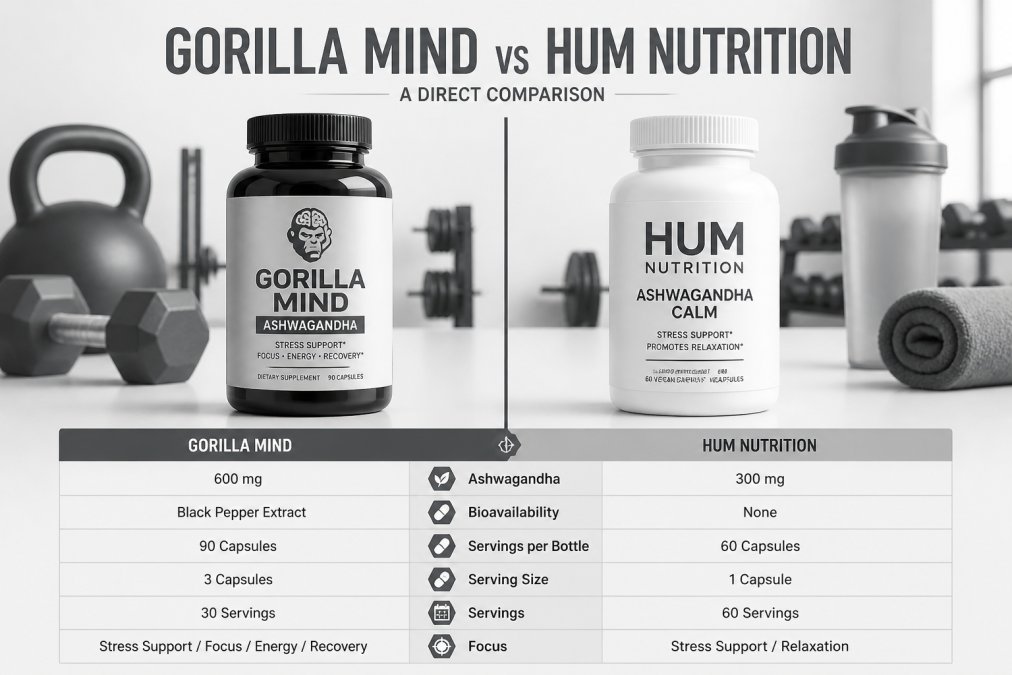
Gorilla Mind vs HUM Nutrition Ingredients: What's Inside Each Formula
Gorilla Mind is a performance-supplement company built around pre-workout, creatine, protein, and a nootropic-style energy formula. HUM Nutrition is a beauty-and-wellness company built around daily capsules for skin, hair, gut, and mood. Only a small overlap exists between the lineups, and that overlap is where a real comparison is possible.
Because the brands don't sell the same product types, compare them category by category, not brand versus brand.
Category 1: Pre-Workout and Energy
Gorilla Mind's flagship is Gorilla Mode, a powdered pre-workout built around 300-400 mg caffeine per scoop depending on the version, plus citrulline, beta-alanine, and betaine.
HUM Nutrition doesn't sell a traditional pre-workout.
Practical takeaway: if you want a scoop you mix before lifting, Gorilla Mind is the only one of the two that actually makes that product. HUM is not competing in this category.
Category 2: Nootropic and Cognitive Support
Gorilla Mind sells a nootropic-style capsule leaning on a stimulant base plus Alpha-GPC and L-theanine, aimed at acute focus for a work block or training session.

HUM Nutrition's cognitive and mood products are daily capsules built on L-theanine, phosphatidylserine, and adaptogenic botanicals, taken every day rather than as an acute pre-task dose.
Practical takeaway: both brands sell a focus product, but Gorilla Mind's is built for an acute hit and HUM's is built for daily background support.
Category 3: Protein, Creatine, and Training Staples
Gorilla Mind sells protein powder, creatine, and other training staples. HUM Nutrition does not sell protein powder or creatine. This is the clearest category split between the two brands.
Category 4: Daily Wellness, Skin, Hair, and Gut
HUM Nutrition's core business is daily wellness capsules: skin, hair, gut, and mood formulas built around ingredients like collagen, biotin, probiotics, and adaptogens. Gorilla Mind does not sell these product types.
What the Labels Actually Tell You
Two label-reading points matter more than any brand claim:
- Proprietary blends. A proprietary blend lists ingredients but not the individual amounts of each. That makes it impossible to verify whether a clinically studied dose of any single ingredient is present. When you see a blend, treat the total blend weight as the only number you can trust.
- Fully disclosed doses. A label that lists a milligram amount next to every active ingredient lets you compare it against the doses used in published human research. This is the single most useful thing to check before buying either brand.
A common pattern in this category is that stimulant-heavy pre-workouts disclose their caffeine content clearly (because it is a safety-relevant number) while keeping pump and nootropic blends undisclosed, and daily wellness capsules disclose more of their individual actives because the formulas are simpler.
FDA dietary supplement labeling guidance
Serving Size and Daily-Use Reality
A pre-workout scoop is a single dose taken before training, so a tub lasts as many days as it has servings. A daily wellness capsule is taken once or twice a day, every day, whether or not you train. That dosing frequency is why the two brands land at very different costs per day.
Effects and Performance: Energy, Focus, and Workout Benefits
The effects you experience differ significantly between these brands, so choose based on your actual use case.
Gorilla Mind users typically report intense energy onset within 15-20 minutes, pronounced mental clarity, and enhanced pump and endurance during training.
The downside: that intensity comes with a potential crash. Users sensitive to stimulants sometimes report jitters, elevated heart rate, or energy crashes 3-4 hours post-dose.
The trade-off: you won't feel the "hit" you get from high-stim formulas. If you're accustomed to aggressive pre-workouts, HUM Nutrition's effects may feel underwhelming initially.
Supplement Third-Party Testing and Quality Standards
Quality assurance is a critical differentiation point between these two brands.
HUM Nutrition maintains consistent third-party testing across its line, checking for heavy metals, microbial contaminants, and label accuracy, confidence that what's on the label is in the bottle.
Gorilla Mind's quality standards vary by product line. Some formulas include third-party testing; others rely on internal quality assurance.
For supplements you consume regularly and expect specific effects from, contamination or mislabeling undermines both safety and efficacy. HUM Nutrition's consistent testing is a meaningful advantage here.
Gorilla Mind vs HUM Nutrition Reviews: User Experience and Ratings
Real user feedback reveals practical strengths and weaknesses lab analysis misses.
Gorilla Mind reviews highlight intense energy and mental clarity during workouts, with users appreciating the noticeable effect and performance gains.
HUM Nutrition reviews emphasize consistency and sustained effects, with improved focus throughout the workday and no crashes.
The user experience gap reflects the design difference: Gorilla Mind is built for acute intensity, HUM Nutrition for sustainable daily support.
Supplements for Brain Fog: Which Formula Delivers Better Mental Clarity
Brain fog, persistent mental cloudiness that kills productivity, responds differently to each formula's approach.
Gorilla Mind's high-caffeine approach provides acute clarity through stimulation.
HUM Nutrition's formula is designed for sustained mental clarity. Moderate caffeine, nootropic compounds, and adaptogenic support address brain fog at multiple mechanisms: boosting energy without overstimulation, supporting neurotransmitter function, and reducing stress-related cognitive decline.
For chronic brain fog, the kind that lingers through your workday regardless of caffeine, HUM Nutrition's sustained approach is more effective.
Cost Per Serving and Value Comparison
Most comparisons stop at a price range. The real math is cost per serving, cost per day, and cost per effective dose. Here's how to run it yourself, since prices move and the answer changes with the product you pick.
The Three Numbers That Matter
- Cost per serving = tub or bottle price ÷ number of servings.
- Cost per day = cost per serving × servings you actually take per day.
- Cost per effective dose = cost per serving ÷ number of ingredients present at a clinically studied amount.
Number three is the one almost nobody calculates, and it is the one that separates a good value from a good marketing budget.
How the Two Brands Differ on Cost Structure
Gorilla Mind's training products come as multi-serving tubs: a pre-workout typically holds 20 to 40 servings depending on formula and scoop size, and protein is sold by total weight.
HUM Nutrition's products come as daily capsule bottles, usually a 30-day supply. Taken every day, the bottle is consumed in a month regardless of training frequency, making HUM a fixed monthly cost while Gorilla Mind's scales with how often you train.
Running the Math on Your Own Cart
To compare the two fairly, do this:
- Note the price and the number of servings on each product page.
- Divide price by servings to get cost per serving.
- Multiply by how many servings you take per day.
- Multiply by 30 to get a monthly cost.
A worked example using placeholder numbers: a $40 tub with 30 servings is about $1.33 per serving. Taken four days a week, that is roughly $5.33 per week, or about $23 per month. A $30 bottle with 30 daily servings is $1.00 per serving, or about $30 per month. The cheaper per-serving product is the more expensive monthly habit, because you take it every day.
Subscription and Bundle Discounts
Both brands offer subscribe-and-save pricing and multi-bottle bundles. A typical subscribe-and-save discount runs 10-20%, and bundles push the effective per-serving cost lower. For a daily product, compare the subscription price, not the one-time price.
What You Are Actually Paying For
- Gorilla Mind: you are paying for a high-dose, fully dosed performance formula. The premium reflects ingredient load, not brand name alone.
- HUM Nutrition: you are paying for a convenient daily capsule with a simpler formula and a wellness positioning. The premium reflects convenience and branding more than ingredient load.
Value Verdict by Use Case
- If you train 3-5 times a week and want a pre-workout: Gorilla Mind's cost per training day is reasonable, and the non-stim version lets you control your caffeine spend separately.
- If you want one daily capsule for focus or wellness: HUM's fixed monthly cost is predictable, but check the label for disclosed doses before assuming the per-serving price reflects ingredient value.
- If you want both: you are paying two monthly subscriptions, so budget for the combined cost rather than comparing them as either/or.
The cheaper cost per serving is not automatically the better value. Compare cost per day and cost per disclosed, clinically dosed ingredient, and factor in subscription pricing, before deciding which brand actually costs you less.
Frequently Asked Questions
How do Gorilla Mind and HUM Nutrition supplements differ in their approach to focus?
Gorilla Mind typically emphasizes high-stimulant formulas with significant caffeine and nootropic blends designed for intense physical performance and mental energy. HUM Nutrition generally focuses on cleaner, non-stimulant cognitive support through adaptogenic and plant-based ingredients. The key difference: Gorilla Mind targets athletes seeking maximum energy surge, while HUM Nutrition targets sustained mental clarity without the crash. Both claim focus benefits, but their ingredient strategies and target audiences differ significantly.
Are Gorilla Mind and HUM Nutrition products third-party tested for quality and safety?
Third-party testing standards vary by product line within each brand. Gorilla Mind and HUM Nutrition both claim quality control, but independent verification differs across their product ranges. When evaluating any supplement, look for certifications from NSF International, USP, or ConsumerLab. Dr. K's Vital Edge products, by comparison, are third-party independently tested for heavy metals and impurities, made in the USA, GMP certified, and produced in an FDA registered facility.
Which supplement is better for brain fog: Gorilla Mind or HUM Nutrition?
For brain fog relief, the choice depends on your sensitivity to stimulants. Gorilla Mind's high-caffeine formulas can sharpen mental clarity quickly but may worsen brain fog in sensitive individuals or cause afternoon crashes. HUM Nutrition's non-stimulant approach supports sustained focus through adaptogens and botanical extracts, making it better for those seeking gradual, crash-free mental clarity. If you struggle with caffeine-related jitters or afternoon energy dips, a clean-focus formula with organic Ashwagandha and cognitive support, like Dr. K's Vital Edge Neuro Plus, can support mental clarity.
How long does it take for Gorilla Mind or HUM Nutrition supplements to work?
Gorilla Mind's stimulant-based products typically show effects within 15-45 minutes due to caffeine and immediate-acting nootropics. HUM Nutrition's adaptogenic formulas often take 3-7 days of consistent use to build up in your system, with full benefits appearing after 2-4 weeks. The timeline reflects their different mechanisms: stimulants act fast, adaptogens build gradually. For immediate focus, Gorilla Mind wins. For sustained, long-term cognitive support without crashes, non-stimulant alternatives require patience but deliver more stable results.